
I passed the bar exam. October to December is a weird period for post like this because it's when new movies that sound good start coming out. (And this year, the Avatar sequel, which I did not have major expectations for but still wanted to see.) It's also weird because I, like many people, tend to watch more horror movies in the month of October. Not to mention that this year there was the Sight and Sound list and all the attending comments and criticism. That's why there's one very, very old film here as well.
Avatar: The Way of Water (2022)

I don't think I'll ever be fully on board with this stuff. The vague "foreignness" of the Na'vi and the smoothness of Hollywood verisimilar CGI put me off. But I appreciated how obvious it was that this movie was made by a vegan who likes to go to the beach, and the fight scene that takes up the whole last hour had surprising momentum.
There is one way in which this film changed my impression of the first one. This movie does nothing to contradict the first one's portrayal of nature as something pure and harmonious, which was one of the easiest things to criticize about it. But now it's clear that this is not the point. It's a device for James Cameron's longing to step outside the human nervous system and become a cetacean leaping out of the water. What if your eye was on the side of your head instead of the front, and what if you had a fin right under your eye?
Again, I can't totally embrace this but I like seeing these minor betrayals of someone's weird desires. You can see it when the film pauses on Kiri just lying in the shallow part of the sea, staring at a hole in the sand underwater where a crab (or some analogous alien) has presumably buried itself. These films are arch-Hollywood, but there's at least a hint of something weird shining through here.
On the Barricade (1906)

This film is only six minutes long, and like most films of its era, it consists of a chain of still shots of different spaces in linear chronological order, though not always with obvious continuity. It's very theatrical, but it benefits quite a bit from snappily alternating locations and from its simple yet evocative compositions, which can change over the course of a single shot. The story arguably doesn't make much sense, but these old films give you so little information that you can't really say that. You can use your imagination to make it basically work.
What I found remarkable about this was a subtle trick it pulls. The main character is a boy who we follow from one location to the next: first his home, then a barricade, then a street overrun with cops and revolutionaries. It repeats these locations, with him as the only character who spans all of them, which emphasizes that his agency is what sets the story into motion. But in the film's final scene, it's not his agency that determines the outcome of the story, but his mother's. Love saves the day, and it's effective because it's surprising: the film takes someone we were not initially encouraged to pay attention to, and shows they're able to intervene in what feels like an inexorable march towards tragedy.
Blast of Silence (1963)

Films noir tend to be world-weary and paranoid. This one is so world-weary that it has no more interest in being paranoid. A hitman goes on a totally routine job, passing through threadbare constructions of the grimiest places in the city, against a chaotic soundscape of jazz, car horns, wind, distant Christmas carols, and an almost comically sleazy narrator that speaks exclusively in the second person. There is, apparently, a lot going on in his head, but it's all confused and caught up in one long dissociative episode. The narrator is rather confident that living or dying doesn't make much of a difference.
It prefigures the extreme violence and postmodern ambivalence of later films like Bonnie and Clyde and Point Blank. But at least those films have organizing principles, or characters who seem to be enjoying themselves. People find them pessimistic because everything is governed by callousness or greed, but Blast of Silence doesn't even give you that. The main character's identity is in tatters from the start. There are inklings that he wants something, but he never forms a clear idea of what it is or becomes fully convinced, in light of all his professional knowledge, that he could ever have it. We don't even get the cold comfort Masahiro Shinoda's Pale Flower offers us, that since we're going to die anyway we might as well look cool doing it. Even so, it's not depressing: it's so thorough in its pessimism that it's all a wash in the end.
Bram Stoker's Dracula (1992)

Few films are so willing to just go for it. From Gary Oldman's haircut to the red sky of Transylvania to the swooning score, it is one of the most extravagant Hollywood movies that doesn't come across at all as whimsical or tongue-in-cheek. Also, while it looks artificial, its attention to the frame's depth and insistent use of in-camera effects give solidity to the strangest things it shows you. The live actors and animals feel contiguous with the most unreal imagery.
It also benefits from the distinctive look of films shot on film. We could create effects with the same weight as the effects in this film using CGI. (Or if we can't, we probably will be able to someday.) However, it's not just about feeling solid, it's about feeling old. It takes place in 1897, after all. We understand the look of film stock as "old" now as a matter of historically contingent fact. But on top of that, its hazy qualities give you the sense of information transmitted from the past, only accessible through imagination and indirect means. The film isn't just called "Dracula," it's called "Bram Stoker's Dracula." It's a story for the times, one which Abraham van Helsing pithily sums up in his line "civilization is syphilization."
Celluloid Nightmares/Re-Wind (1988)

The graphic sex and violence in this film make it hard to recommend to most people. But if that doesn't bother you, don't hesitate. This film is in the same vein as Serial Experiments Lain, Kiyoshi Kurosawa's Serpent's Path, and many other anime and Japanese films that practically compose a whole subgenre of horror. But Celluloid Nightmares predates them by ten years. It shares the same themes of ennui and social contagion, and similar imagery: oppressive urban environments and glowing screens filling up indeterminate dark spaces with staticky transmissions that could be coming from ghosts.
A killer wields a handheld camera attached to a knife, a clear reference to Michael Powell's Peeping Tom, and people pick up his gruesome videos after he leaves them at a shop for adult films. It's an appropriate place to leave them, because when people watch them, they aren't repulsed. They're intrigued and even titillated. In the city, the camera points up at towering office buildings, then spirals down to where the characters are on the street. In a place like this, dominated by such faceless and indifferent monuments, the idea of infinitely customizable delusion, planted and replanted in our minds by the ubiquity of TV screens and availability of handheld cameras, becomes a new kind of temptation.
Decision to Leave (2022)
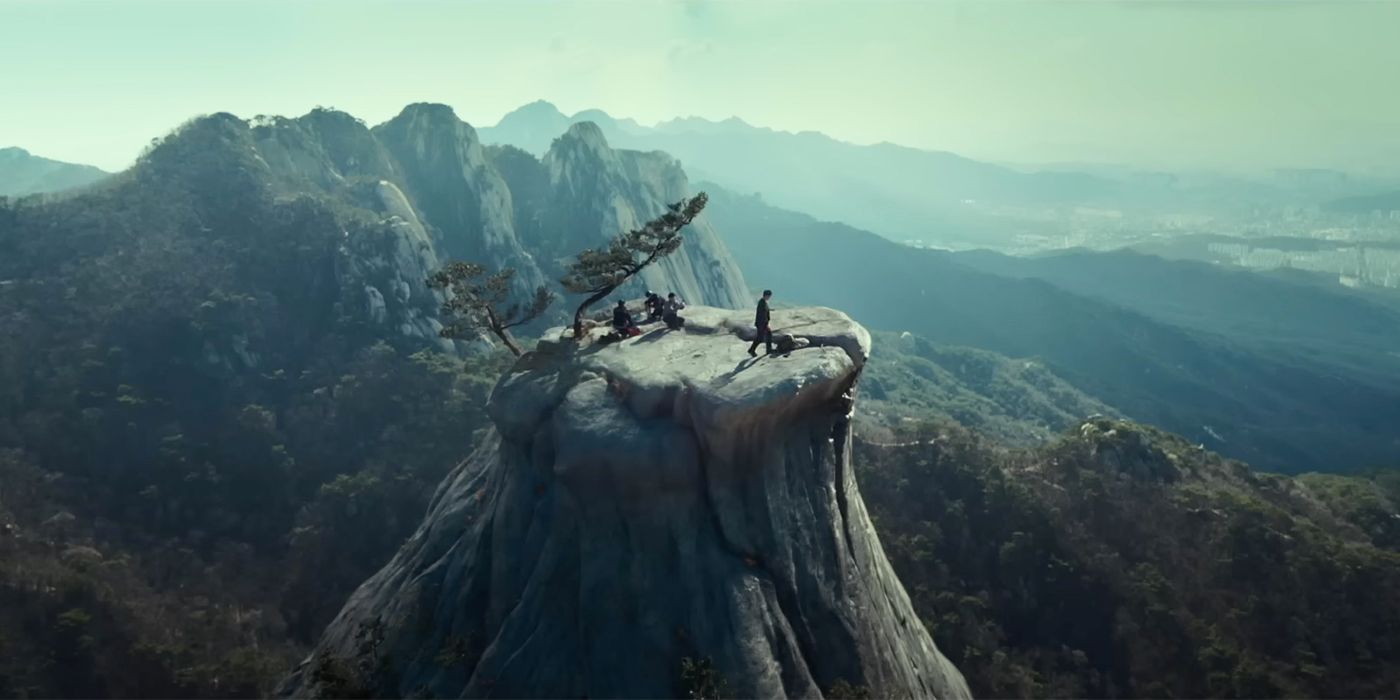
Comparisons to Hitchcock are almost too obvious with how much this film lifts from Vertigo. (Whether it has much in common with Hitchcock's other films is left as an exercise for the reader.) It borrows Vertigo's twofold mystery: on the surface, there is the mystery of how a murder was committed, and by whom. Implicit is the mystery of what drives the characters, why they can't pull themselves away from self-destruction. But while Hitchcock's films generate the second mystery through performance and subjectivity, this film does so by making us wonder why we're seeing exactly what we're seeing. It often cuts from one thing to the next in inexplicably matching images. Some scenes mislead us into believing certain things are happening simultaneously when they are not. Others show us something imaginary without announcing it first.
Like in Hitchcock's films, the story offers us psychosexual explanations of the characters' behavior. But these do not form the central subject matter of the film. Rather, they're part of the broader selection of things that overdetermine their behavior. The title says it all, really. We want to know if these characters can leave behind the destructive paths they find themselves drawn to. If you've seen Park Chan-Wook's other films, this film's answer may not surprise you.
Venus Wars (1989)

It's very much fixated on the characters at the expense of paying attention to how the war is proceeding overall. Later, the gang gets recruited by the military. We hear about the mission they're assigned, then they go to battle. But as soon as one of them is struck down, we fade to black and lapse to after the battle is over, glossing over the outcome. This may be attributable to the film's need to condense a large amount of story from the original manga, but it works to set the mood, sometimes jaded and sometimes intimate, of characters who fight for no reason other than that they're tired of wartime and want it to be over sooner.
Comments
Post a Comment